The years between 15-25 are frequently a time of questioning and great discovery, but like many others I found them difficult. I had to deal with chronic disease, failure in my chosen career, a persistent lack of self-worth along with indecision about an alternative career path, and loneliness.
Although never diagnosed, a psychologist would probably have called me depressed.
However, along the rugged path to recovering my childhood inner contentment I found that spiritual activities like prayer, research into some of the world’s most meaningful spiritual writings and participating in church were keeping me sane, mentally motivated, and connected to others in a nurturing environment.
The refocus on unselfish activities gave me a feeling of self-worth again and also contributed to a hopefulness that things would get better. In time, it opened up previously unknown pathways to fulfillment.
Rather than restricting me or quashing my critical thinking, my adolescent research into the spiritual nature of mental and physical health made me realise that what I needed all along was to put into daily practice a growing understanding of my radically awesome relationship to the Divine Being.
To the degree that I acknowledged it, I found that I could actually experience divine Love expressing kindness and unselfishness in me; the divine Mind reflecting intelligence and wisdom in me; the divine Life demonstrating health and wellbeing in me; and so on (ideas from Science and Health by Mary Baker Eddy).
Things started to go right for me again. You could say that I saw “the wilderness and desert begin to blossom as the rose”, an image so beautifully depicted in the Bible.
Perhaps not surprisingly, I ended up more consistently in the right head space with a much better view of myself – and was probably a lot more likeable, as well!
A 2008 study published in Australian Family Physician and written by Dr Craig Hassed, Faculty of Medicine at Monash University in Melbourne, reported that “Spirituality is an important determinant of physical, emotional and social health…”
When commenting on escalating trends in youth mental illness his study suggests that “there may be too little attention being given to the ‘protective factors’ against mental illness, of which, particularly for adolescents, are connectedness and having a spiritual or religious dimension to one’s life” (Hassed, The role of spirituality in medicine, 2008).
It’s heartening to learn that spirituality is acknowledged as central to youth mental health by a growing number of psychologists.
It seems to me that clinicians need to speak to the community more about the benefits of spirituality in the treatment of anxiety and depression, and not just in young people, but for everyone.
A spiritual dimension to life will undoubtedly assist you, whether you’re young or old, as you seek (and find) a better, healthier and happier you. That would be the real you!
Not Limiting God – Readings from the Bible and the textbook of Christian Science, Science and Health with Key to the Scriptures by Mary Baker Eddy.
When man is governed by God, the ever-present Mind who understands all things, man knows that with God all things are possible (Science and Health p180).
Every Wednesday at 6.15 pm a Testimony Meeting is held at the Christian Science Church in Canberra. Each meeting begins with readings selected from the two books designated as the Pastor of Christian Science: The Bible and Science and Health with Key to the Scripturesby Mary Baker Eddy. A new topic for the readings is selected each week.
At the conclusion of the short readings the congregation is invited to share thoughts on this topic and relate how they have used the principles of Christian Science to solve life’s problems and bring physical healing.
If you are in Canberra on any Wednesday please join us. Everyone is welcome.
This recording represents the readings on the topic:Not Limiting God.
Here in Canberra winter is now upon us. The yellow and gold trees have given way to bare branches and we have already had our first frosty mornings.
Many of us who have lived in Canberra for a while have come to love this climate and its four distinct seasons. With each there are certain expectations: the regenerating bloom of the spring heralded by the brilliance of the wattle; the long dry heat of the summer and trips to the coast; the vivid colours of the autumn and the swirling brown leaves.
The crispness of winter, the clear blue skies and trips to the snow are often accompanied by calls to be wary of colds and flu. TV commercials remind us of the available remedies and we are sometimes tempted to wonder whether we will ‘go down’ with something this year, or will we be lucky?
Nowadays there is a strong body of evidence that attests to the influence of one’s thought on health. For over 100 years now we have been aware of the placebo effect: the apparent strong positive effect of sugar pills and non-medicated treatments on patients who believed them to be remedial agents. These experiments alone must ask us to question the nature of the effect of thought on the body. To question how the quality of our consciousness and our belief systems can affect our wellbeing? There is also growing evidence to suggest that spirituality, our natural attraction to the good and the true, has a positive impact on physical resilience and recuperation.
About 150 years ago Mary Baker Eddy investigated this link between spirituality and health. Her experiments and study culminated in her textbook: Science and Health with Key to the Scriptures. In it she states (p208): Mind, not matter, is causation. A material body only expresses a material and mortal mind. … You embrace your body in your thought, and you should delineate upon it thoughts of health, not of sickness.
She goes on to say (p392): The physical affirmation of disease should always be met with the mental negation. Whatever benefit is produced on the body, must be expressed mentally, and thought should be held fast to this ideal. If you believe in inflamed and weak nerves, you are liable to an attack from that source. … If you decide that climate or atmosphere is unhealthy, it will be so to you. Your decisions will master you, whichever direction they take.
Reverse the case. Stand porter at the door of thought. Admitting only such conclusions as you wish realized in bodily results, you will control yourself harmoniously. When the condition is present which you say induces disease, whether it be air, exercise, heredity, contagion, or accident, then perform your office as porter and shut out these unhealthy thoughts and fears. Exclude from mortal mind the offending errors; then the body cannot suffer from them. The issues of pain or pleasure must come through mind, and like a watchman forsaking his post, we admit the intruding belief, forgetting that through divine help we can forbid this entrance.
Let’s determine this winter to hold thought to the higher qualities of Truth and Love, of wholeness and harmony and turn away from contemplation of disease, and so build our spiritual immunity.
This article was contributed by Deborah Packer of Canberra.
To purchase a copy of Science and Health with Key to the Scriptures by Mary Baker Eddy click here.
The issue of violence is prominent in our community conversations at the moment. Terrorism, drug-related violence, domestic and institutional abuse, and even road rage are insistently crying out for our attention and solutions.
Despite serious efforts over many years to prevent violence, to deal with its effects and to punish the perpetrators, there’s now general agreement that violence will continue to escalate and to propagate fear in the community until we find and treat the real causes.
Fundamental beliefs that underlie and perpetuate all kinds of violence are: that humans have an animal nature prone to competition, self-preservation and aggression; that certain brain-based dysfunctions may be the root of addiction and violence, aggravated by abuse or neglect during childhood; and that there are deeply rooted social and cultural patterns, leading to a distorted sense of manhood and womanhood, that may take generations to change.
However, there’s evidence that these beliefs may be just that …. either long-held or fairly recent beliefs that need to be revised.
Drugs and alcohol are often associated with violence. People working in the police and community services speak of how addiction and abuse reoccur from generation to generation, and there is now general realisation that special attention needs to be given to the families involved.
However, there is some progress as communities work together to fight apathy and educate each other that this cycle can indeed be broken.
A retired commanding officer in the police force shared one such approach: “…anytime I knew I was going to a call related to domestic conflict or violence I would pick up the local pastor.” Often they were able to provide a spiritual viewpoint and connection that would later solve the problem.
It is often acknowledged that recognising a man’s spiritual nature has a healing effect.
Significant psychological research studiesfind that spirituality is not only helpful to, but integral to mental health. This is an important point in considering individual and whole-society wellbeing.
We may need to adjust our thinking about our real nature.
Another long-held false belief will be overturned by realising that the spiritual qualities generally attributed to women – such as care for others, gentleness, forgiveness and patience – and those qualities attributed to men – such as wisdom, truthfulness, tenaciousness and strength – are innate in both men and women.
Jesus’ ability to express both the fatherhood and motherhood of the divine set the benchmark for us. And like him, we’re actually “tuned in” to hear spiritual intuitions that will prompt, direct and uplift thought, although we may choose not to listen.
Knowing that no-one can be excluded from hearing and acting on divine thoughts can help to overcome violent impulses and begin to heal the culture of violence.
A pioneer in investigating the effects of our thoughts on our health, Mary Baker Eddy, recognised this voice as the ever-appearing of “the divine message from God to men speaking to the human consciousness.”(Science and Health with Key to the Scriptures)
When Susannah (not her real name) moved out of home and obtained a copy of that book, she just loved the way the author described the divine power that governs the universe as Father-Mother.
Her family had suffered violence at the hand of her father for many years. To think her father could be capable of reflecting the gentle motherhood of God seemed absolutely impossible. However, she decided to stop wrestling with this idea and worked hard to try to see him as reflecting this tender divine nature; learning that he wasmeantto be nurturing, gentle, tender.
Susannah was listening for the divine message, which replaced the macho view of her father and other men, with this new view of men. Her thought and experiences gradually began to change.
As the weeks went by, she learned that her parents had not had a fight in months and her father was treating her mother and sister with new tenderness. Eight years on, this is still the case.
A scientific approach to thought and prayer in this way does not whitewash evil deeds; rather it exposes the mistaken beliefs and causes them to be discarded.
Further changes in thinking about her own spiritual nature, meant that Susannah no longer saw herself or her mother as survivors of mental, verbal or physical intimidation, but as well-adjusted and balanced individuals.
She had no lingering emotional scars, but had learned truly to love and see the undamageable good in herself and her mother.
As Australian of the Year and domestic violence survivor, Rosie Batty, advocates, Susannah truly took responsibility for her own life, bringing vital change to those around her in the process.
Such approaches hint at the possibilities for healing the culture of violence in ourselves and in the community.
Sometimes life throws up situations where you have to stick to what you understand to be true, even if the physical evidence is saying something else. I suppose that’s a bit like Copernicus, when he was starting to realize that the earth rotated around the sun, and not what was commonly thought, he had to use his scientific understanding and not the popular opinion or even his physical senses.
I’ve had experiences, simpler, humbler ones, where I’ve had to stick to a spiritual understanding of what was going on and not just accept the outward sense of things. One of these times was when my dog, Ben, was hit by a car.
Ben had suddenly spotted by husband across the road and run straight out into the path of a car. The car, a huge four-wheel drive, had hit him, spearing him into the ground, the full force being taken by his head. And although there were only a few external abrasions, it was obvious something serious had happened to his skull. We took him home and I began to pray immediately.
Now my younger daughter was, at that stage, growing up and she was making her own mind up about things, and we’ve always respected our girls’ rights to think differently to us. And she felt very strongly that we should take him to the vet. She was actually shouting at me, and it was not easy, but I over rode her objections, and I did this for several reasons. I had more faith in God than in man. I had seen so many healings in my life, particularly of animals, that I had absolute confidence that the dog could be healed, but also I actually did not think that he would survive through any other means. So I just went to God for help.
I prayed through the night to know only what God would know about the situation, to know that His divine care was ever present and all powerful, that divine Love did not cause this accident so it had no divine authority, that His almighty care surrounded us and governed the scene with harmony. And as the day dawned, it suddenly became clear that I absolutely believed, and understood, God’s unwavering, unchanging love for all of His creation; that the Ben’s life was safe because he had always been in God’s care, and I knew it and I believed it and understood it more than what the physical senses were telling me.
Shortly after, my daughter came in to check on him and he leapt straight up into her arms perfectly well and happy, with all symptoms and pain completely gone. And within two days even all evidence of the abrasions was gone. But, as importantly, my daughter received the evidence that she needed as well.
This article was submitted by Beth Packer, a Christian Science healer from the South Coast of NSW, Australia.
Four ‘trick or treaters’ knocked on our door on Halloween evening. Somewhat unprepared and surprised to experience this novelty in Australia I managed to locate a few sweet treats for each of them, and they left happily bubbling with excitement.
Was I frightened of their costumes or weird masks? Of course not. And I’m sure they didn’t believe for a moment that they’d suddenly morphed into ugly, wicked or ghoulish creatures, either.
Sometimes, though, people do put on an emotionally draining mask as they strive to feel accepted and loved. Over time they may come to accept the charade as part of themselves.
For instance, they may act out the role where they have to be the best … at everything. They can’t abide mistakes and feel it’s a badge of honour to say they’re a perfectionist. Ever in fear of failing, they may be chronic procrastinators. They don’t like themselves very much either, because they rarely live up to their own expectations.
They may be caught up in a warped view of the world that is commonly known as perfectionism.
Like many psychologists, Thomas Greenspon believes that perfectionism is more than pushing yourself to do your best to achieve a goal; it’s a reflection of an inner self mired in anxiety, where you constantly feel like an imposter. “Perfectionist people typically believe that they can never be good enough, that mistakes are signs of personal flaws, and that the only route to acceptability as a person is to be perfect,” he said.
Whatever the reason may be for that belief, at the heart of the often life-long anxiety to appear perfect is our adoption of the general belief that the human mind is full of good and bad emotions and beliefs, some of which are detrimental to mental and physical health.
However, what’s gaining wider acceptance in health research today is the degree to which the body is the servant of the mind.
Sometimes a simple shift in thought enables us to take off the imposter’s mask we may have been wearing and lift the mental weight.
Accepting a less human mind for a diviner nature that is more attuned to understanding, compassion and humility, brings with it greater confidence, better relationships and a selfless desire to contribute to the greater good.
It’s the daily diet of serene, spiritual thoughts that transforms our experience, gives us grace for each day and best feeds our famished affections, Mary Baker Eddy, the discoverer of Christian Science, explains in a very practical elucidation of the Lord’s Prayer.
It’s interesting that current treatments for perfectionism are also moving to thought-based approaches such as acceptance and commitment therapy, meditation and mindfulness, even in the treatment of serious eating disorders like anorexia nervosa and bulimia nervosa that develop alongside the obsessive quest for the perfect body.
Reports estimate that 15% of Australian women between 12 and 30 years of age suffer from eating disorders at some stage in their lives. These young women (and men) who are crying out for love, acceptance and a better view of themselves, often cause untold anguish for themselves and their families, and sometimes even end their lives in the quest for the perfect body.
Julie Bell reached the point where hospitalisation for malnutrition seemed the only answer when the application of a distinctive thought-based, prayer-based approach, founded on recognition of her flawless, spiritual nature, proved “a glorious turning point”.
She experienced a shift in thought. She realised that she could take control of her own thinking, that her body was the servant and that “food did not have power to govern (her) life or (her) sense of a physical body”.
Not only healed of the eating disorder, she found that other obsessive habits that she hadn’t realised were abnormal completely fell away, as did her fear of going forward in the world.
If you’re tiring of the relentless obsessive or perfectionistic thinking about your body or successes, you may also be more than ready to focus less attention on what you eat or on your limited achievements and more on thinking outside the sensory box. Instead, pondering ideas that tenderly reassure you of your intrinsic value.
The mask of a limited, biophysical viewpoint can be frightening, but its removal will enable you to replace a daily diet of fear and anxiety with a moment-by-moment health-giving intake of love and respect for your perfect, beautiful, spiritual self. The difference will be remarkable.
This post was written by Kay Stroud who is a freelance writer focussing on the undeniable connection between our thinking and our health. She writes for metropolitan and regional news media throughout Australia and beyond, and is a regular contributor to Australia’s national forum, Online Opinion.
While some of us are still dealing with the influx of visitors, festivities and sun-soaked holidays, in the back of our minds is the niggling thought that 2015 has already begun and now is the time to make our New Year’s resolutions, before it’s too late.
Some are choosing to eat healthier and exercise more. That certainly can make us feel better.
Two other resolutions that go hand-in-hand will not only increase your health but be game-changers in your life: always opt for the positive viewpoint over the negative and choose to be kinder to others.
A friend related how his acquaintance was in hospital recently, suffering from a life-threatening illness.
Things were looking pretty grim and it seemed that he was hanging on by a thread. Then his heart stopped and he ceased breathing.
At that moment, the medical staff on duty in that area of the hospital noticed that he was passing on and began to congregate around his bed …. not rushing to him with defibrillator or drip, but unexpectedly telling jokes, laughing and talking loudly and animatedly about everyday things.
They continued by his bedside including everyone in the ward in the jovial conversation until he began to regain consciousness. The man made a full recovery.
What happened? Did the nurses and doctors know that their confident and caring presence was more effective than apparatus or medication? Yes.
Something similar is at play when a teacher disregards the negative ‘label’ attached to the child and responds with love and recognition of that child’s higher nature and abilities, bringing a turnaround in attitude at school.
Or when a brick wall tumbles down between two people who haven’t spoken to each other for years as one reaches out with forgiveness.
The reasons for such changes for the better spring from (1) choosing a positive, solution-based approach, and (2) trusting our instinct to be warm and caring, despite a temptation to take an impersonal, defeatist or hard-line approach.
Lissa Rankin MD, sought-after TEDx presenter and one of the keynote speakers at the Byron Bay Uplift Festival a few weeks ago, urges us to strip back everything that isn’t really us that we’ve learned in the world of hard knocks, to find that inner pilot light or divine spark of love within.
Research results from studies on cancer recovery and remission support her claim to the beneficial effects of this practice.
Rankin also cites conclusive evidence that an essential part of any successful treatment is engaging a health practitioner who is reassuring, gentle and kind, and treats patients with compassion.
Did Jesus mean in his well-known parable, that the warmth and care that the Good Samaritan showed had as much to do with the traveller’s recovery (who was robbed and beaten by thieves) as the bandages, oil and wine provided?
Mary Baker Eddy believed so and based her scientific, healing method on this premise. An important researcher into how consciousness affects health, she discovered in her investigations and successful treatments through prayer that…
Forgetting ourselves and putting others first really FEELS divine and invariably makes us glow with happiness.
I hope your 2015 takes wings. Seems it’s sure to do so if you choose to take this two-pronged approach to a happier, healthier year ahead – adopting a positive, solution-based viewpoint, and actively and warmly caring for yourself and others.
Kay is a freelance writer focussing on the undeniable connection between our thinking and our health. She writes for metropolitan and regional news media throughout Australia and beyond, and is a regular contributor to Australia’s national forum, Online Opinion.
The Psalm of Love … Psalm 23 – Readings from the Bible and the textbook of Christian Science, Science and Health with Key to the Scriptures by Mary Baker Eddy that were inspired by the 23rd Psalm.
Every Wednesday at 6.15 pm a Testimony Meeting is held at the Christian Science Church in Canberra. Each meeting begins with readings selected from the two books designated as the Pastor of Christian Science: The Bible and Science and Health with Key to the Scripturesby Mary Baker Eddy A new topic for the readings is selected each week.
At the conclusion of the short readings the congregation is invited to share thoughts on this topic and relate how they have used the principles of Christian Science to solve life’s problems and bring physical healing.
If you are in Canberra on any Wednesday please join us. Everyone is welcome.
This recording represents the readings on the topic: The Psalm of Love … Psalm 23.
Psalm 23
The Lord is my shepherd; I shall not want.
He maketh me to lie down in green pastures: he leadeth me beside the still waters.
He restoreth my soul: he leadeth me in the paths of righteousness for his name’s sake.
Yea, though I walk through the valley of the shadow of death, I will fear no evil: for thou art with me; thy rod and thy staff they comfort me.
Thou preparest a table before me in the presence of mine enemies: thou anointest my head with oil; my cup runneth over.
Surely goodness and mercy shall follow me all the days of my life: and I will dwell in the house of the Lord for ever.
The Prayer That Heals– Readings from the Bible and the textbook of Christian Science, Science and Health with Key to the Scriptures by Mary Baker Eddy.
Every Wednesday at 6.15 pm a Testimony Meeting is held at the Christian Science Church in Canberra. Each meeting begins with readings selected from the two books designated as the Pastor of Christian Science: The Bible and Science and Health with Key to the Scripturesby Mary Baker Eddy. A new topic for the readings is selected each week.
At the conclusion of the short readings the congregation is invited to share thoughts on this topic and relate how they have used the principles of Christian Science to solve life’s problems and bring physical healing.
If you are in Canberra on any Wednesday please join us. Everyone is welcome.
This recording represents the readings on the topic: The Prayer that Heals.
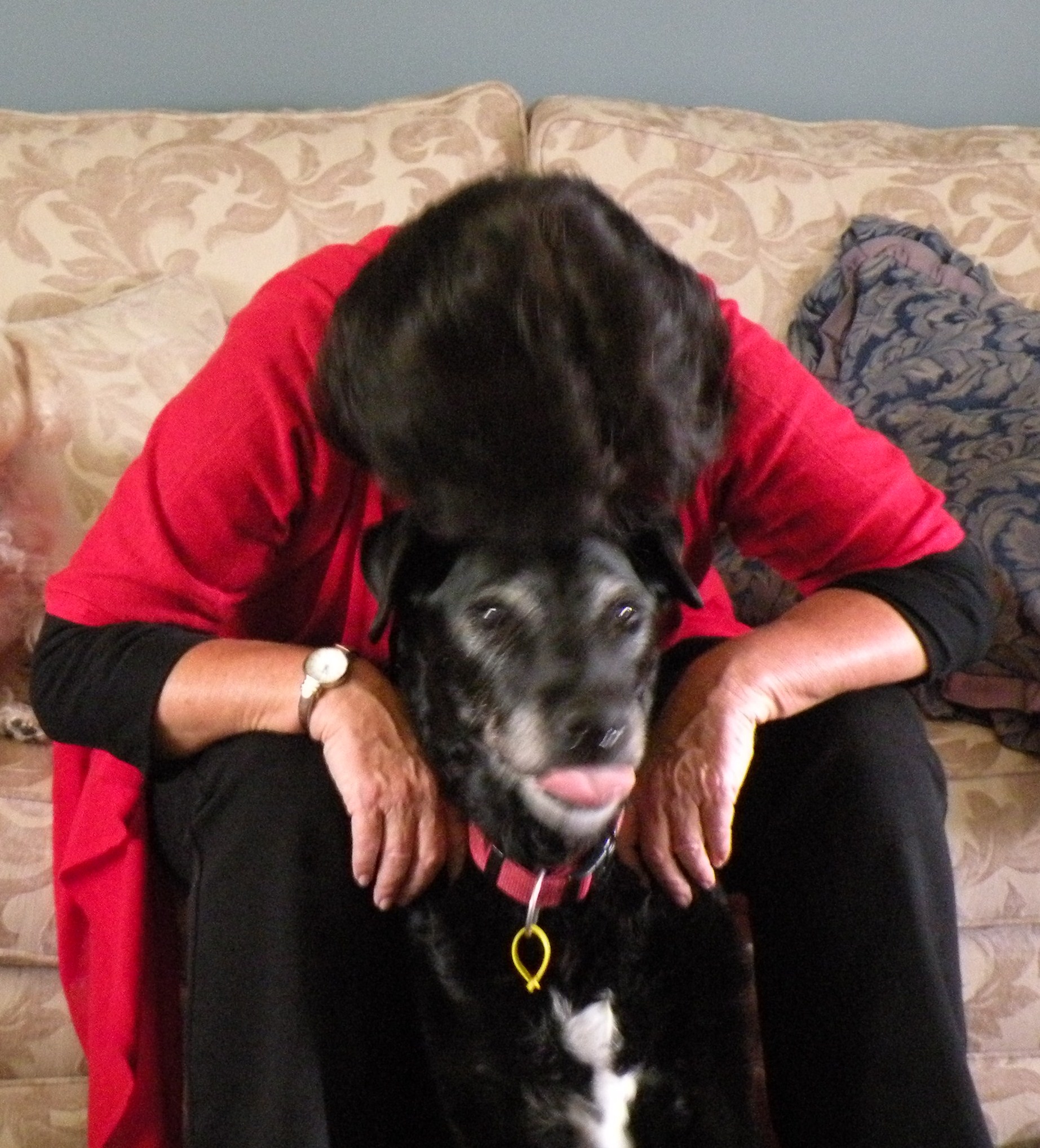
It’s been a year now since Monty left us. We guessed he was about four when he came to us. He had been trained as a bomb squad dog but his boundless energy and unstoppable joy for life rendered him unsuitable for such a delicate and serious career and he was adopted out. His new owners also found him a handful and he moved to a temporary home and then to another longer stay, but these owners too were unable to meet his needs.
When he came to our attention we were looking for a family dog and without even meeting him we somehow knew that he was the right dog for us. He proved to be perfect! He revelled in our long walks through the bush, the runs up our local Mt Taylor and just being one of the boys with our son and his friends.
When our son grew up and left home Monty prompted me from my somewhat sedentary life style and made sure that I had regular long walks. No matter what the weather he was always keen to be out. He brought joy to any activity. He adored us; he would put himself between me and any perceived danger. I have no doubt that he would lay down his life for any one of us. He fiercely protected our home and the variety of cats and chooks and guinea pigs that he saw come and go in our family.
Once a year he had a trip to the vet. When we had had him for about seven years the vet warned us that Monty may not be back next year. He cautioned that dogs of his type were not long lived and that Monty had ‘done well’. The following year we returned and gently the vet suggested that we prepare for Monty not being with us much longer. I was noticing that our walks were getting slower and shorter and most days now he would sleep a deep sleep much of the day. When he was awake he was happy and well, but he slept most of the time. It occurred to me that the vet was right and that he may just slide away.
This idea did not sit well with me and I prayed about it. Not a prayer asking God to make it right, but a prayer that seeks a better understanding of the truth of the situation; a prayer that confirms the good and denies the wrong. I could accept that animals come and go in our lives but I could not accept that life was a downhill slide into oblivion. The qualities we loved about Monty: love, affection, devotion, loyalty, energy, exuberance, joy, protection, selflessness, constancy – these were spiritual qualities and as such they were immortal. They could not be contained or curtailed by a material body. They were independent of matter.
“Except for the error of measuring and limiting all that is good and beautiful, man would enjoy more than threescore years and ten and still maintain his vigor, freshness, and promise. Man, governed by immortal Mind, is always beautiful and grand. Each succeeding year unfolds wisdom, beauty, and holiness.”
I thought on these ideas for a few weeks applying them to Monty. Gradually over this time he became more wakeful and his old energy levels returned. We were back doing our brisk five kilometer walks and still he had energy. In fact one day my husband asked if I had been praying for Monty. ‘If so’, he said, ‘Could you stop now – he has more energy than I can cope with.’
Monty stayed with us for nearly five more years. His joy for life remained till the end. Even on his last morning he watched me eagerly to see whether I was putting on my walking shoes in case there was the chance of a walk.
I learned many lessons about life from living with Monty but most importantly I learned that we can say NO to suggestions of age.

 The years between 15-25 are frequently a time of questioning and great discovery, but like many others I found them difficult. I had to deal with chronic disease, failure in my chosen career, a persistent lack of self-worth along with indecision about an alternative career path, and loneliness.





 While some of us are still dealing with the influx of visitors, festivities and sun-soaked holidays, in the back of our minds is the niggling thought that 2015 has already begun and now is the time to make our New Year’s resolutions, before it’s too late.

 Christian Science Canberra