Today, more than any other time, we have access to what feels like an infinite stream of information. YouTube videos are available to give us instructions on everything from tying our shoelaces to building a house. Opinions are proffered like facts. Influencers share their ‘wisdom’ on every aspect of life. Digital platforms with ideological agendas have the power to shape individual and public opinion. AI-generated content looks real, but isn’t, and misinformation can spread more easily than truth. Is there a reliable way to find truth, to discern which ideas have integrity and value and which don’t deserve our attention?
The statement: ‘The time for thinkers has come’ is from the opening page of the textbook of Christian Science, Science and Health with Key to the Scriptures. It was written 150 years ago by Mary Baker Eddy, the founder of Christian Science. Even back then Eddy recognised the need for us to show wisdom, to be discerning, to sift fact from fiction and opinion.
Christian Science provides an invaluable guide in this respect. It teaches that the term God means the rules that make life work harmoniously. It teaches that God is Love. If ideas and actions come from a place of kindness, respect, unselfishness, forgiveness then they are based in Love and deserve our attention and support because these are the qualities that make life worthwhile.
Christian Science also teaches that God is Principle. If ideas and actions promote lawfulness, justice, fairness, discipline, steadfastness, trustworthiness, diligence, efficiency, stability in ourselves and society, then these are ideas with integrity.
When we recognise God as infinite Mind then ideas and actions that represent the qualities of divine Mind have value. Intelligence, wisdom, understanding, perception, alertness, insight, innovation, curiosity, inventiveness are the qualities that add value to ourselves and our communities.
God is also known as Spirit. Are new ideas directing us towards consumerism and materiality or are they lifting thought towards more enlightened thinking? Do they give a sense of peace and joy?
Knowing God in these ways not only makes God relevant to everyday life but also gives us the ability to be critical thinkers, to sift through the daily avalanche of information, to recognise which ideas have integrity and deserve our attention, and which do not. This is how we become the thinkers that the world has need of.
This article was originally published in the January 22, 2026 issue of the Canberra Weekly. It was written by a member of the Christian Science community in Canberra.
This recording is of the readings on the topic:The Lord Was Not in the Fire.
.
Fear not, I am with thee, O be not dismayed, For I am thy God, I will still give thee aid; I’ll strengthen thee, help thee, and cause thee to stand, Upheld by My gracious, omnipotent hand;
When through fiery trials thy pathway shall lie, My grace, all sufficient, shall be thy supply; The flame shall not hurt thee; I only design Thy dross to consume and thy gold to refine.
A member of the Christian Science community in Canberra was interviewed by Jenny Sawyer for a Sentinel Watch podcast titled Prayer: What’s It All About? In this she explains how she prayed when faced with difficult situations.
Prayer: What’s It All About? (Part 2) Click here to listen.
An article by a member of the Canberra Christian Science community (alternatively titled: Practice is essential) which was published in the 6 October 2025 issue of the Christian Science Sentinel.
I was walking across the lawn at the front of our house, enjoying the cool, squishy feeling of the grass under my bare feet, when suddenly there was an agonizing burning in my left foot. I live in Australia, where there are many things that bite and sting, and a pain of that magnitude is not a good thing. I spun around, looked down, and saw that I had been stung by a large wasp.
An often-used expression in Christian Science is “Know the truth.” It comes from Christ Jesus’ instruction “Ye shall know the truth, and the truth shall make you free” (John 8:32). Immediately, I did so, and as quickly as the first truthful, healing thought came, the pain left. There was no evidence of a sting, and I had no further reaction to it.
So what does knowing the truth really entail, and how can we be instant in our knowing of this truth that heals and protects?
As you can imagine, I was really grateful for the instantaneous nature of this healing. But healings are also wonderful learning experiences. Instead of thinking, “Wow! I’m glad that awful situation has passed,” I value how healings can help me to learn more about the law of God, divine Love, which governs me and all situations. I stop and think, “What worked there? Where was my thinking—was it on God or on the situation itself? What can I learn from this that will help me to be a more effective healer?”
I learned two lessons from this incident with the wasp. … Click here to read the full article: Practice is essential
This article was contributed by a member of the Christian Science community in Canberra. It was published in the September 19, 2025 issue of the Canberra Weekly magazine.
Most of my friends are not believers in God. Some say straight out that there is no God. Others ask: If there is, is He or She relevant to today’s modern world. They tell me that they can be good people and live happy lives without believing in a mystical being.
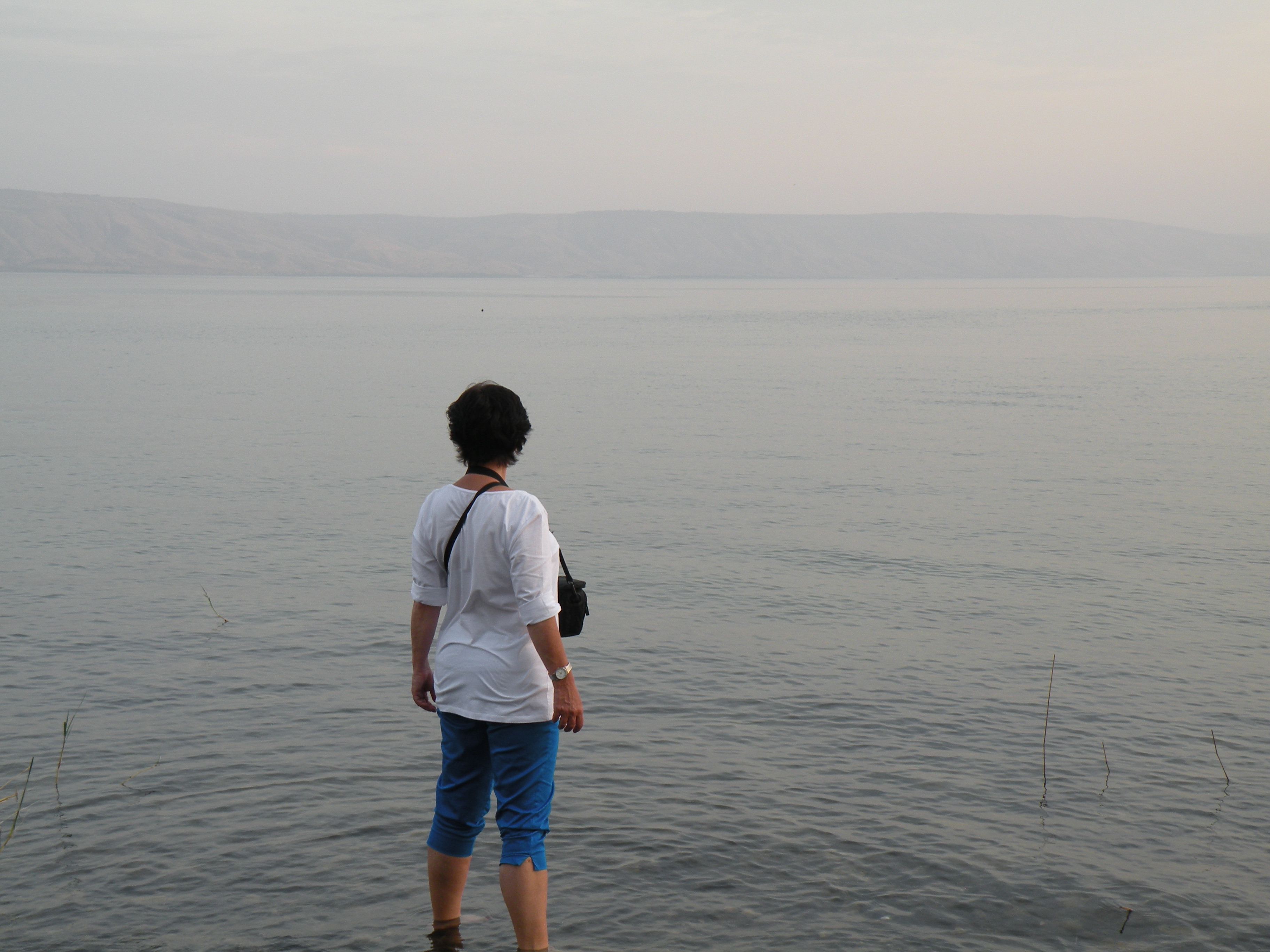
Standing in the Sea of Galilee.
If I didn’t have a Christian Science background, I would definitely be with them and not be a believer either. Christian Science shows me a concept of God that helps me make sense of the world. Christian Science is Bible based. While we understand that much of the Bible is allegorical and meant to be interpreted from a spiritual perspective and not taken literally, Jesus’ instructions we do take seriously. He gives us the rules that help us live a better, more productive life.
From Jesus we learn that God is Principle, or law maker. We also learn that God is Love (I John 4:8). Not that God is loving, but that God IS Love. Love has so many shades: kindness, affection, loyalty, generosity, forgiveness, empathy, cooperation. This list goes on. These are the qualities that make life seem worthwhile and that bring peace and harmony to any situation. You will notice that none of these qualities has a material form or is restricted to a particular place – they can be anywhere and everywhere at once. It is said that it is Love that makes the world go around. I don’t think that a world completely devoid of Love could exist! It is essential to existence.
The opposite to Love is hate – cruelty, selfishness, retaliation, greed, stubbornness. These are the qualities that tear families and societies apart. They bring no joy. The world, right now, is in great need of more of the love qualities and less of the hate.
If God is Love then we know something of the nature of God. God is not a material being; God can be everywhere at once; God is essential to life. Knowing God as Love allows me to see God everywhere – in every act of kindness or generosity, in every smile.
Knowing that God is both Love and Principle, or law maker, gives me trust that Love will always be victorious. For me, putting God first, means putting Love first and this is one way I can bring peace to each experience.
Heal me, O Lord, and I shall be healed; save me, and I shall be saved: for thou art my praise.
(The Bible -Jeremiah 17:14)
God will heal the sick through man, whenever man is governed by God. Truth casts out error now as surely as it did nineteen centuries ago.
(Science and Health with Key to the Scriptures by Mary Baker Eddy p495: 1-3)
“God is Love.” More than this we cannot ask, higher we cannot look, farther we cannot go.
(Science and Health with Key to the Scriptures by Mary Baker Eddy p6: 17-18)
Love is impartial and universal in its adaptation and bestowals. It is the open fount which cries, “Ho, every one that thirsteth, come ye to the waters.”
(Science and Health with Key to the Scriptures by Mary Baker Eddy p13: 2)
Children today are growing up in a vastly different world to the one their parents experienced. The fast pace of technological change, the lure and risks of social media, the prevalence of cyber bullying, the easy availability of drugs and alcohol, and even the sensational reporting of world events all put pressures on our youth. How can we help them to navigate these challenges and give them the tools they need to cope with the everyday life challenges of school, study, work in 2025?
Today more than ever, our young people need to have a strong moral compass to help them make wise decisions, and an inner resilience that helps them meet life’s challenges and rise above adversity. Hara Estroff Marano, Editor-at-Large for Psychology Today, wrote in her article “The Art of Resilience”: “At the heart of resilience is a belief in oneself—yet also a belief in something larger than oneself. Resilient people do not let adversity define them. They find resilience by moving towards a goal beyond themselves, transcending pain and grief …” So how do we fortify our children and develop in them an understanding of their innate ability to rise above adversity? As parents, we cannot be with our children 24/7 how can we help them to know that they are safe and loved?
At the Christian Science Sunday School in Canberra we do just that. In small groups with a teacher, students discuss the qualities that help us live successful and harmonious lives. Lessons are based around the Ten Commandments and the teachings of Jesus including the Lord’s Prayer. Students discuss the issues that come up in their own lives in light of these invaluable character guides.
Classes for students from pre-school up to age 20 are held every Sunday at 10.00 am. Babies are cared for in the creche. New students are always welcome. The Sunday School is located with the Christian Science Church at the corner of Macquarie and Bligh Streets in Barton. Local students attend in person, but Zoom is available for those who are more distant. For more information click on the Sunday School tab in the menu bar at the top.
Already it’s 2025! Sometimes a new year will cause us to reflect on the year just gone and consider whether we made the most of the opportunities it presented; whether we learned from the challenges; whether we progressed in some way. More likely we will be thinking ahead. Will this be the year I lose weight, exercise more, find a better job? We may even set goals for ourselves.
If we are honest, we must admit that most of our goals are personal ones aren’t they? There is nothing wrong with wanting to be a better version of ourselves in some way, but what if our goals were larger? What would the world be like if we all decided to contribute to making the world a better, more peaceful place? Traditional Christmas carols express hope for ‘peace on earth, good will toward men’. What if this desire was not just a line in a song but our personal goal?
You might ask: How can I make a difference? The world is in such a difficult state – there is poverty, and there are wars, and terrible injustices. How can I help with that, you ask? Every thought and every action contribute to the mental atmosphere of our environment. Are we contributing to a more peaceful environment in our daily interactions? Are we patient and supportive when the person behind the counter is new at their job? Are we gracious in traffic when someone inadvertently cuts us off? Are we forgiving when a waiter makes an error in our order? Are we generous to those less fortunate than ourselves? Every one of these actions contributes to your own and others’ feeling of being loved and valued. Isn’t that what we all need? Isn’t this what really makes life work right?
The Golden Rule: ‘ Treat others as you would want to be treated’, isn’t just a Christian saying. A quick Google search reveals that it is a core demand of every major religion and school of thought. The world knows that it is love that makes things work right. This time next year when we look back on 2025, let’s hope we can all say that we contributed to the peace of the world. Starting right here with our everyday actions we can do our part in building peace.
This article was contributed by Deborah Packer, a member of the Canberra Christian Science community.
For those who seek to know how to think and pray about conflict take comfort in these readings from the Bible (KJV) and Science and Health with Key to the Scriptures by Mary Baker Eddy on the topic: Love – the Only Response to Conflict.
True forgiveness – is it possible? If someone has really hurt you in ways that seem impossible to ignore, is it necessary to forgive them? Is it actually possible?
Jesus is quoted as saying (Matt 5: 38,44) Ye have heard that it hat been said, An eye for an eye, and a tooth for a tooth: … But I say unto you, Love your enemies, bless them that curse you, do good to them that hate you, and pray for them which despitefully use you, and persecute you; Why did he say this? Is it realistic? Is it wisdom?
We don’t ever have to condone or excuse unacceptable behaviour. It is only right that laws and courts deal with unlawful behaviour but world events tell us that ‘an eye for an eye’ thinking does not bring peace.
In this same passage, Jesus goes on to say that we are the children of God – God who is Love. Our true nature then is loving. This gives us the strength to move beyond hurts. When you truly know who you are, it is possible to find your freedom from negative, limiting feelings. Hurt and resentment fall away in the knowledge that you are the loved and loving child of God.
We should remember that the world is wide; that there are a thousand million different human wills, opinions, ambitions, tastes, and loves; that each person has a different history, constitution, culture, character, from all the rest; … we should go forth into life with the smallest expectations, but with the largest patience; with a keen relish for and appreciation of everything beautiful, great, and good, but with a temper so genial that the friction of the world shall not wear upon our sensibilities; … determined not to be offended when no wrong is meant, nor even when it is, unless the offense be against God. (Miscellaneous Writings p223)
This is how we find our peace.
This article was contributed by a member of the Christian Science community in Canberra.









 Christian Science Canberra