Archive for the ‘spiritual identity’ Tag
An article from the Christian Science Monitor by Blythe Evans
When my children were in elementary school, they played soccer through a local sports program. Before each game, the coach would assign each child a player on the opposing team to “mark.” That meant to focus on and stay right with the player at all times, rather than meandering around the field of play. Sometimes the coach would even say, “Mark that player so closely you feel like you’re in their shirt! Stay right with them.”
The importance of this was not lost on the young athletes, and the better they each marked their player, the better the game went for them.
I think of this sometimes when I read in the Bible, “Mark the perfect man, and behold the upright: for the end of that man is peace” (Psalms 37:37). Practically speaking, who is “the perfect man” we are to “mark”? How do we do that? And why should we?
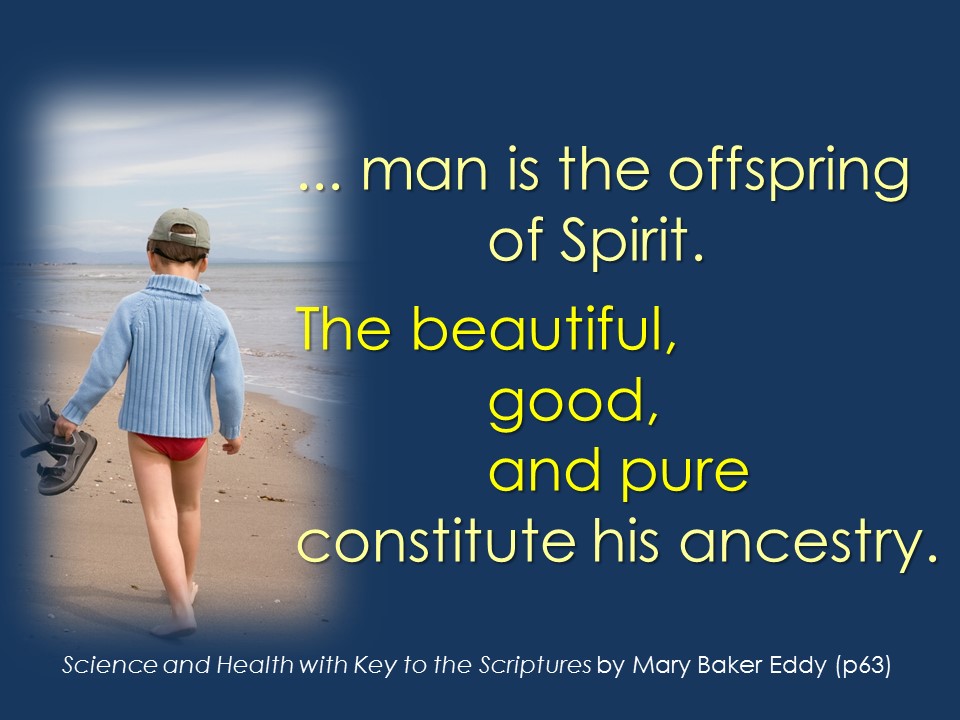
Well, it is clear there is no perfect human being, so the “perfect man” must be a higher, more spiritual concept of man than we experience with our material senses. In fact, the teachings of Christian Science help us see that the “perfect man” is the spiritual man (meaning all of us) of God’s creating, made in the image of divine Spirit.
Blythe goes on to explain how this reasoning and spiritualisation of thought brought about a quick healing of her young grandson’s injured finger. She concludes by saying:
This doesn’t mean putting our heads in the sand when we or someone we encounter is not well or acting wrongly. Rather, we can silently affirm that everyone’s true nature is one of harmony, health, and integrity, because God, Spirit, is all good. Understanding this enables us to overcome illness or bad character traits, and to help others do the same.
Click here to read the complete article.
.
The divine Mind maintains all identities, from a blade of grass to a star, as distinct and eternal.
(Science and Health with Key to the Scriptures by Mary Baker Eddy p70: 12)
An article by Lindsey Biggs from the Christian Science Monitor.
Where does our worth come from? A particular job? How much praise we get from a job well done? Many of us have had to wrestle with such questions.
Lindsey writes:
There was a point when I desired additional employment. I felt there were greater ways that my skill set could be used than in what my role at the time offered.
I regularly turn to prayer when I need help or guidance. Prayer gives me a clearer sense of my (and everyone’s) relation to God. I’ve found that getting a clearer view of what God sees and knows helps me experience more harmony.
In this instance, my prayers led me to write a “spiritual resume” – not to share with prospective employers, but to help me think more deeply about where our true worth lies. What I mean by this is I compiled a list of spiritual qualities I felt I expressed, such as patience, creativity, compassion, timeliness, order, self-discipline, etc.
Click here to read, or listen to, this short article where Lindsey explains how a change of thinking from a material to a spiritual basis brought about long-term, satisfying employment.
When spiritual being is understood in all its
perfection, continuity, and might, then shall man be found in God’s image.
.
(Science and Health with Key to the Scriptures by Mary Baker Eddy p325:13)
 The years between 15-25 are frequently a time of questioning and great discovery, but like many others I found them difficult. I had to deal with chronic disease, failure in my chosen career, a persistent lack of self-worth along with indecision about an alternative career path, and loneliness.
Although never diagnosed, a psychologist would probably have called me depressed.
However, along the rugged path to recovering my childhood inner contentment I found that spiritual activities like prayer, research into some of the world’s most meaningful spiritual writings and participating in church were keeping me sane, mentally motivated, and connected to others in a nurturing environment.
The refocus on unselfish activities gave me a feeling of self-worth again and also contributed to a hopefulness that things would get better. In time, it opened up previously unknown pathways to fulfillment.
Rather than restricting me or quashing my critical thinking, my adolescent research into the spiritual nature of mental and physical health made me realise that what I needed all along was to put into daily practice a growing understanding of my radically awesome relationship to the Divine Being.
To the degree that I acknowledged it, I found that I could actually experience divine Love expressing kindness and unselfishness in me; the divine Mind reflecting intelligence and wisdom in me; the divine Life demonstrating health and wellbeing in me; and so on (ideas from Science and Health by Mary Baker Eddy).
Things started to go right for me again. You could say that I saw “the wilderness and desert begin to blossom as the rose”, an image so beautifully depicted in the Bible.
Perhaps not surprisingly, I ended up more consistently in the right head space with a much better view of myself – and was probably a lot more likeable, as well!
A 2008 study published in Australian Family Physician and written by Dr Craig Hassed, Faculty of Medicine at Monash University in Melbourne, reported that “Spirituality is an important determinant of physical, emotional and social health…”
When commenting on escalating trends in youth mental illness his study suggests that “there may be too little attention being given to the ‘protective factors’ against mental illness, of which, particularly for adolescents, are connectedness and having a spiritual or religious dimension to one’s life” (Hassed, The role of spirituality in medicine, 2008).
It’s heartening to learn that spirituality is acknowledged as central to youth mental health by a growing number of psychologists.
It seems to me that clinicians need to speak to the community more about the benefits of spirituality in the treatment of anxiety and depression, and not just in young people, but for everyone.
A spiritual dimension to life will undoubtedly assist you, whether you’re young or old, as you seek (and find) a better, healthier and happier you. That would be the real you!
This article, by Kay Stroud, has been published in the Sunshine Coast Daily, Lismore Northern Star and Bundaberg News Mail. Kay is a freelance writer focussing on the undeniable connection between our thinking and our health.







 Christian Science Canberra