Archive for the ‘Wellbeing’ Category
 The four-hourly doses of morphine were such a welcome relief to the intense pain I was experiencing following major surgery. What could possibly make me give them up?
I found there was something that could persuade me to do so. And that’s why, I want to share my experience with sufferers of chronic pain.
In Australia, one in five people live with chronic pain, including adolescents and children. This prevalence rises to one in three people over the age of 65. Chronic pain is linked to depression and suicide and is Australia’s third most costly health condition.
To manage it, a range of treatments such physio and physical therapy, medical acupuncture, thinking strategies, lifestyle changes, nutrition and traditional prescription opioids, are employed.
Despite this, pain is often long-lasting and continues for years with no foreseeable end.
However, I’ve joined a groundswell of people that believe it’s time to do more than simply manage pain. We are convinced it can be reduced, and even healed.
According to a 2011 report, “one reason pain is so hard to treat is that it isn’t just physical.” Our thinking can actually have an impact on the amount of pain we feel.
The power of our expectations is illustrated in a series of trials into the relationship between pain and the placebo effect. Hundreds of patients treating irritable bowel syndrome, migraine and back pain experienced similar or better results from placebos than from strong pain killers.
While it’s agreed that placebos are not a universal panacea, placebo research leads us to think about how much influence thought actually has on our health.
Reasoning from a more spiritual perspective, author Mary Baker Eddy, reached a similar conclusion, explaining that pain is always a mental image or state.
But can pain really be relieved just by thinking differently?
Yes, but in my experience I have found that it needs more than just positive thinking to free us from pain.
So, back to my stay in hospital. In my late-teens I was “on fire” with enthusiasm about a couple of unique books which I had recently revisited. They answered so many of the questions I had about why we are here and whether what our senses perceive is all there is to existence.
The Bible, so comforting to so many people, didn’t seem all that relevant to me until I started reading Science and Health, which brings out its spiritual meaning and explains how and why not only Jesus, but also his early disciples and many of the Old Testament prophets, were able to heal all kinds of physical needs.
I learned that there was a spiritual science in place based on a divine consciousness of being.
My studies had shown the importance of addressing the spiritual need as an aid to recovery, a standpoint now supported by medical research.
I started reading the thought-changing book again right there in hospital, and called a Christian Science practitioner to pray with me by helping me to understand more consistently my real, spiritual nature.
I can still remember the feeling of love and wholeness that engulfed me soon after. No more drugs were needed, and worrying digestive difficulties painlessly dissipated that day.
On this basis, many have been healed of acute and chronic pain, and demonstrated that such pain need not last forever. Peace and health are a present possibility for those willing to dig deeper into the understanding of their spiritual identity.
This article was contributed by Kay Stroud, a life-long Christian Scientist, who is a freelance writer focussing on the undeniable connection between our thinking and our experience including our health. She writes for metropolitan and regional news media throughout Australia and beyond, and is a regular contributor to Australia’s national forum, Online Opinion, and the APN regional network in Northern NSW and Queensland.
A Christian Science lecture by Stormy Falco
![article.271029.large[1]](https://christiansciencecanberra.com/wp-content/uploads/2016/07/article-271029-large1.jpg?w=238&h=317) In this hour-long lecture, Discover God – Discover Health, Stormy describes her recovery from a paralysing terminal illness.
In this hour-long lecture, Discover God – Discover Health, Stormy describes her recovery from a paralysing terminal illness.
When she had nowhere else to turn, Stormy turned to God in prayer – a God she did not know very well, whose existence she had often doubted and who now was the focus of her anger.
She studied the Bible and the textbook of Christian Science, Science and Health with Key to the Scriptures by Mary Baker Eddy, and learned that God was Love; God did not send sickness. As her understanding of God grew her health improved. She learned that there were divine laws that sustained and maintained man. As she learned to apply these laws she was restored to perfect health.
Stormy is now a full-time Christian Science healer and teacher. She has travelled the world sharing what she has learned about spiritual healing.
This lecture was given in the Clayton Community Centre in Melbourne and was sponsored by the Christian Science Church in Ringwood.
The Christian Science Church – a part of the Canberra community. Members share testimonies and talk about their lives as Christian Scientists.
 This article, A Prayer and a Cat, is by Debbie who is a member of the Christian Science Church in Canberra. She describes how her prayers for the world also resulted in healing for a friend’s cat.
I would like to share a healing that happened some years ago but it’s one that has meant a lot to me.
At the time I was working as a teacher in a local primary school. There was one particular colleague that I sat with sometimes at lunch; she often talked to me about her cat, Hershey, who seemed to be a big part of her life. However, at this particular time much of her conversation was about her upcoming trip to the US – a holiday for which they had been saving for a long time.
One day I walked into the staff room to find this friend crying gently while she ate her sandwich. I sat with her and asked what had upset her. She said that Hershey was sick and the vet had said he would die any day. She was supposed to leave for the US in a few days and no cattery would take a cat that was about to die. The kindest thing to do, the vet said, was to put him to sleep before she left.
My friend couldn’t bring herself to put her beloved cat down and felt guilty that she was leaving him when he was so ill. Yet the holiday couldn’t be cancelled at this late date.
Without thinking too much I said: “Would you like me to mind Hershey?” Immediately she jumped at this idea and within the minute it was settled. She said she understood that he would not be alive when she returned but that at least he could go in his own time and in comfort. I agreed.
Two days later Hershey was delivered to my place. I admit I was not prepared for the sight of him. He lay motionless in his basket; he was skin and bones with dull tufty fur and sore spots; his eyes remained closed. I was informed that he needed his own quiet, dark room with no interruptions except for his medication. I had not considered the issue of medication. He had so many! She explained that Hershey had an immune deficiency condition – a cat’s version of AIDS she said. We installed Hershey in his room and she said her good-byes.
For two days I tried to give Hershey his medication but it seemed to cause him so much stress. I couldn’t see the point so I stopped. I had been brought up in Christian Science and had always solved problems quickly through prayer. Prayer for me was not a passive asking God for help but an active change of base in my thinking and spiritual reasoning.
There had been a lot of news coverage at this time around the issue of AIDS and I had been praying about this. In my reasoning I went back to my basic beliefs: I believed that there was a controlling order or principle to the universe and that principle was Love – another name for God. A God of love I reasoned could not make a dangerous universe; that a God of Love protected creation, it didn’t expose it to harm. I had proved many times that holding to spiritual truths, even in the face of evidence to the contrary, resolved inharmonious situations.
Now I applied this reasoning to Hershey. He was part of Love’s creation and I knew this Love was a powerful force for good. In the textbook of Christian Science, Science and Health with Key to the Scriptures, Mary Baker Eddy writes: You embrace your body in your thought, and you should delineate upon it thoughts of health, not of sickness (p208) so I embraced Hershey in my thought in this way. I didn’t dwell on him, but I held to this idea every time I did think of him. I felt safe that he was safe.
Very quickly he began to respond. In a day or so he was up and walking about his room; another day or two he was out and exploring the house.
At the end of two weeks my friend returned and phoned to see how things had gone with Hershey. She was very surprised to hear that he was ready to be picked up. When she arrived to collect him he was sitting on the back of the lounge in the sun looking out the window. He was plump and healthy, his fur was flawless and sleek and shiny, and he had a playful sparkle in his eyes. He was very glad to be going home.
Sometimes when I pray for the world I am tempted to wonder: Are my prayers doing any good? This experience with Hershey gave me further proof that spiritual truths are powerful, more powerful than material evidence, and that prayers are effective in bringing about harmony in any situation – even those given up as hopeless. I continue to be grateful for all that I am learning in my on-going study of Christian Science.
The Christian Science Church – a part of the Canberra community. Members share testimonies and talk about their lives as Christian Scientists.
 My name is Jen and I am a member of the Christian Science Church in Canberra. I love learning about other people’s religions – I hope that some of you will love learning about mine.
Although Christian Science is very much based on what Jesus taught us, I often describe it to atheist and agnostic friends as a blend of Buddhism and Quantum Physics. This is because it has a focus on overcoming a material view of the world, and understanding God as a spiritual life force. It also presents us with a set of rules that we can use to understand God and His relation to man: spiritual laws that are the basis of reality.
So what does this mean for me, as a Christian Scientist? It means that I work every day to bring spirituality into my experience, and have seen healing as a result. I lived in Indonesia for a year and attracted a lot of attention as a fair-haired, blue-eyed foreigner. I developed anxiety during my time there due to the constant staring, catcalling and sexual harassment. When I came home to Australia, I struggled to shake the anxiety, which made me incredibly tense, neurotic and irritable. It took me a couple of years of prayer to overcome my anxiety: it was clear that I was safe, but I was facing mental suggestions that I should hold onto fear to protect myself.
I had the choice of turning to a powerful God who created me free of fear, to a God who made me feel unsafe and fearful, or to no God at all. I chose the first, as praying to know that I am the spiritual creation of a loving God has brought me healing in the past. I had a major light-bulb moment in this case when I realized that the opposite of anxiety is expecting good. I replaced thoughts of fear and anxiety with thoughts of safety and optimism, knowing that an All-Powerful God would always protect His creation. This allowed me to free my thought from fear, and I have felt relaxed and protected ever since.
This is a testimony of how I understand God and myself, and also of how I use Christian Science prayer in facing the challenges in my life. I use the laws that Jesus taught us to overcome limited views of myself, and rid myself of fear in living a peaceful life.
The Christian Science Church – a part of the Canberra community. Members share testimonies and talk about their lives as Christian Scientists.
 This article, Gratitude for Healing – Headaches No More, is by Barbara who is a member of the Christian Science Church in Canberra. She relates how she has found permanent freedom from headaches through prayer and spiritualisation of thought.
Recently I read a beautiful expression of gratitude from a student of Christian Science who related how he had been healed of headaches.
It reminded me that I too had been healed of headaches so many years ago that I had really almost forgotten about it, and that healing has been permanent.
I was a fairly new student of this Divine Science at the time, and had never before experienced an instantaneous healing. My job was such that I was continually dealing with the public, and it was important to be pleasant and attentive at all times. That is not easy with a throbbing head.
I thought about God, the one and only power, and asked myself if I thought that He could have a headache. The answer was no, I did not believe He could. So then I asked myself again if I could possibly have something that God did not have, and certainly could not give me, and remain pure and loving. The answer was still no, and at that moment I was entirely free of any pain. That freedom has been mine for more than fifty years now.
Having said that, I cannot claim that the feeling of a headache coming on has not knocked at the door of my consciousness, but it has gained no admittance. I have confronted it in various ways, such as “get thee hence, Satan”, to use the words of Jesus (Matt 4:10). Satan is a Hebrew word signifying an adversary, an enemy, an accuser; or simply I would say, “I don’t do headaches” which is not very scientific, but I know that I do not have to cover the same ground again, and what God has done is done forever.
In obedience to the teachings of Christian Science I take the advice given in the textbook Science and Health with Key to the Scriptures by Mary Baker Eddy where Mrs Eddy says, “Stand porter at the door of thought. Admitting only such conclusions as you wish realised in bodily results, you will control yourself harmoniously” p392: 24-27. Similarly, to quote the Bible again, “Resist the devil, and he will flee from you.” (James 4:7).
Through the study of the Bible and the Christian Science textbook I am assured that ‘with God, all things are possible’.
The Christian Science Church – a part of the Canberra community. Members share testimonies and talk about their lives as Christian Scientists.
 This article, Healing Like an Awakening, is by Christine who is a member of the Christian Science Church in Canberra. She shares how a deeper understanding of God as Principle helped to bring about the healing of a restricting physical condition.
Mary Baker Eddy, the discoverer of Christian Science has an interesting definition of this Science: “To live so as to keep human consciousness in constant relation with the divine, the spiritual, and the eternal, is to individualize infinite power; and this is Christian Science.”
My study and practice of this Science of Being has resulted in a deep sense of peace, joy and gratitude. I am learning how thought is vital to my everyday experience and keeping my consciousness in relation to the divine, is the key to an awareness of what is real.
Many times I experienced that what was first so real, so frightening, so painful was changed totally by a change of perception, a change of thought, the realization that we are not alien to the divine Principle, or law, but are truly one with the divine Life.
I would like to explain this further with a physical healing that happened some years ago. I grew up with the practice of Christian Science Mind-healing and so it was very natural for me to turn to it in every need. So when I became ill with symptoms that were never diagnosed (listlessness, sleeplessness and no appetite) I turned to God for a greater sense of wholeness and perfection. I worked with a Christian Science healer but my condition did not change until I became quite frail.
My husband gave me an ultimatum one day and asked me to see a medical practitioner. I could see that this was a reasonable request but it also somehow awakened me to expect healing and a change in my thought that I had been working on every day – a kind of transformation. That night when I could not sleep, I got up and walked around our kitchen and thought of 7 synonyms or names for God that Mary Baker Eddy explains in her book Science & Health. These are: Mind, Soul, Spirit, Principle, Life, Truth, Love.
I often ponder them when I want to get a clearer idea of what God means to me and I did this aloud at this time of great need. For example, I thought of how my life was an expression of the one big Life, Life that could never get limited, disharmonious. There is Truth that always frees us from limitations and how Love is the one cause of all being. When I came to the concept of a divine Principle, or law, something suddenly cleared in my thinking. I realized that I was connected to the law of Life, the law of being – everyone was. I bathed in that thought and it became like a light and also something of substance I could lean on, something that had indeed great power.
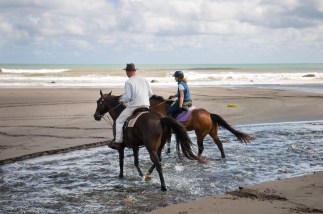
During this prayerful time I became very calm and eventually I returned to bed and for the first time in weeks, slept peacefully. In the morning I was well, ate a big breakfast and although I had been quite weak, there was no need for recuperation. I quickly gained my normal weight and started living an energetic life once more. In fact just two days after the night time turn around, I saddled my horse and went for a long ride through the countryside with such a sense of unbounded freedom. The healing suddenly felt so natural, as if all that had happened was that I had woken up and realized that all was well.
The Christian Science Church – a part of the Canberra community. Members share testimonies and talk about their lives as Christian Scientists.
 This article, How I Came to Christian Science, is by Fran who is a member of the Christian Science Church in Canberra. She shares the events that led her to the study of Christian Science.
Just over 25 years ago I experienced the worst day of my life. Up till then I had always been a pretty obedient, happy, traditional church goer. I was even a Sunday School teacher. This day left me with only shock, horror and such immense grief. These all combined to make me decide, “Well if that’s God, I don’t want any more to do with any of it”. A bit later from somewhere I dredged up enough humility to question was it me or God that had led me to this point?
I had a peripheral knowledge of Christian Science gathered from watching, and often arguing with, a few family members. At this stage I felt lost and desperate enough to try attending a Christian Science church service here in Canberra (which was not my home city at the time). My first visit didn’t last very long as I knew I was about to break down; I quietly left. However, a vigilant usher noticed me and whispered to a practitioner in the congregation – a Christian Science practitioner is someone who supports others through prayer. I was sitting in my car hunched over the steering wheel howling when I became aware of this lady sliding into the seat beside me. Hers was an unforgettably special and loving presence.
After talking for while she extracted a promise from me to visit her home. However, I had to cancel because of the onset of severe migraine. She offered to pray for me for this. Not only was the relief immediate but now some 25 years later I can declare with joy and gratitude I have never had another. My following visits to her were instructive, up-lifting and above all filled with love, and gently led me into serious study of this practical Christianity.
Through my study of Christian Science I now understand God as Love and I know that He is not the cause of tragedy, or inharmony of any kind. He is in fact the force that protects and saves us. How immensely grateful I am to God for what I now know I have within me to share.
The Christian Science Church – a part of the Canberra community. Members share testimonies and talk about their lives as Christian Scientists.
 This article, A Quick Healing of a Turned Ankle, is by Julie who is a member of the Christian Science Church in Canberra. She describes how she prayed when she sprained her ankle at work.
I work in a large, busy primary school. The week before last while rushing around in the morning organising relief staff for the day at school I rolled my ankle. Immediately I held firmly to the idea that God is always in control and that He loves me and protects me; that I was actually safe in His care. I went about my day joyously running between classrooms working with teachers and students.
However, by mid-afternoon I realised that I couldn’t walk. My ankle was swollen and throbbing. I felt that I couldn’t think. My colleagues became very concerned for me and wanted to take me to the hospital. I told them I was fine. I held to what the Bible tells me about man in the first chapter of Genesis: that I was made in the image and likeness of God – even though in the human sense I was in excruciating pain. I had to attend professional learning that afternoon so my colleagues lovingly drove me to and from the workshop. Things were so busy all afternoon I felt overwhelmed and couldn’t find any quiet time just to listen to my beloved Mother-Father God.
I arrived home after 7pm. Friends called and insisted that I elevate my ankle and apply ice. I lovingly told them that I would do so to alleviate their fears. I knew that I just wanted to have time alone. While having a hot shower I was earnestly praying to God and I realised that God’s love was law and it would adjust any inharmonious situation. I knew I had to be joyous. With that instant thought I walked out of the shower knowing all was well. I felt joy just bubbling out of me as I knew I was walking normally.
I arrived at school the next day just after 7am to begin yet another busy day. My colleagues, one by one throughout the day, approached me see how I was. They were amazed that I was about my usual busyness. They couldn’t believe I was running, skipping and walking everywhere across the school. They wanted to know what happened. I told them I just needed to pray. Some looked at me oddly. I said that I hadn’t been to a doctor for over 20 years. I just prayed when any health issues arose in my life. Furthermore, when any challenge ever arises in my human experience I just pray to God. I frequently ring a practitioner and they support me with prayer until there is harmony.
The Christian Science Church – a part of the Canberra community. Members share testimonies and talk about their lives as Christian Scientists.
 This article, Peace of Mind Restored, is shared anonymously by a member of the Christian Science Church in Canberra. In it the writer tells of his triumph over a debilitating medically diagnosed mental health condition.
As with many others it has been a journey for me to find, accept and gain an understanding of Christian Science.
For almost ten years I have relied entirely on Christian Science to overcome all medical problems. No pills, medicines or drugs of any kind – purely and only Christian Science.
All my life prior to this period I had relied on traditional medicines and doctors. I had been diagnosed with manic depression and mild schizophrenia with associated suicidal thoughts and tendencies. General practitioners, psychiatrists and psychologists had been consulted. I had close to two decades of changing medications and altering dosages, and yet nothing really changed. Homeopathy and hypnosis had even been tried. I just thought this was the way it was and would continue to be.
After an attempted suicide (obviously unsuccessful) I had a stint in hospital and it was there that an event occurred that changed my life: The psychiatrist at the hospital told my wife, ‘there is nothing we can do to stop the suicide attempts; he will do it again; one day he will succeed’. This was the turning point in my life. I knew I had few options so I turned to Christian Science and found a firm fundamental premise upon which to expand my life.
Since turning to Christian Science and studying the text Science and Health with key to the Scriptures by Mary Baker Eddy I have been healthier both physically and mentally. My family report that I am calmer, happier and kinder. I can truly agree with Timothy in the Bible when he says: God hath not given us the spirit of fear; but of power, and of love, and of a sound mind (II Timothy 1: 7).
As I said previously: no medicines, formulas or pills for almost ten years. The constant in this time has been Christian Science and the text, Science and Health with key to the Scriptures by Mary Baker Eddy. It was a journey to get to that point and the time was right for me.
The Christian Science Church – a part of the Canberra community. Members share testimonies and talk about their lives as Christian Scientists.
 This article, Why I Chose Christian Science, is by Rod who is a member of the Christian Science Church in Canberra. He shares what following the teachings of Christian Science has meant to him.
When people ask me why I chose Christian Science and why I stay with it. My response is always: Because it works!
Those already exposed to, or involved with, Christian Science will understand this response. Let me explain.
Over the last seven years I have had just one headache. That is one headache in seven years. Prior to taking up Christian Science I had had a headache every day for more than a decade. After years of consulting with doctors I had no permanent solution to this problem. For more than ten years I consumed more than the recommended dose of pain killers every single day. Try as I might I was unable to break this cycle. I was also on a range of other medications for other medically diagnosed conditions.
When I decided to take up the study of Christian Science I gave up the pills and decided to rely on prayer for a solution. Since taking this stand I haven’t needed to resort to painkillers and I haven’t had a need for any medication at all in seven years. In this time I have only had one minor headache. I am attributing this solely to my greater understanding and acceptance of Christian Science. This is the single factor I can pinpoint in this turn around.
I recommend Mary Baker Eddy’s book, Science and Health with key to the Scriptures, to anyone wishing to make fundamental changes in their life. It is not an ‘easy read’ but is definitely life changing.


